PEX-A · copper · slab leak re-routes
Repipes, Re-Routes & Repairs
These three belong together because they are the same decision at three different scales. A pipe is leaking: do you repair that section, abandon and re-route the run, or replace the system? Getting that answer right is worth more than the work itself — the wrong call is either money spent on a house that needed a repipe, or a repipe sold to a house that needed a fitting.
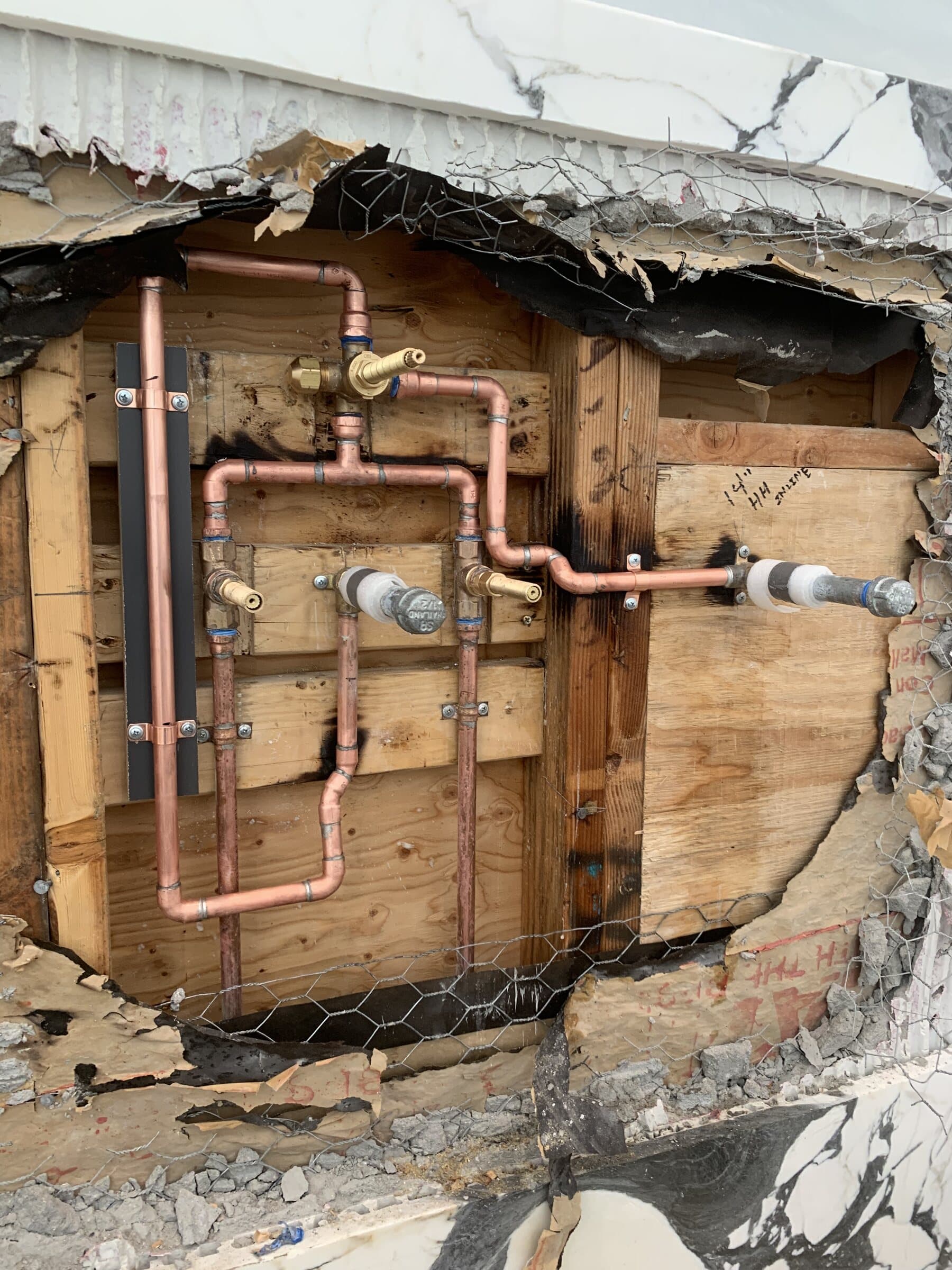
Repairs
Most leaks are a repair. A failed fitting, a nail through a line during someone else's remodel, a split at a valve — those get fixed, and the system around them is fine. We will tell you when that is what you are looking at, including when it costs us a much larger job.
- Copper and PEX repairs
- Pinhole leak repair
- Failed fittings, valves and angle stops
- Water line repair under sinks and in walls
- Hose bib, PRV and main shutoff replacement
Slab leak re-routes
When a line under the slab fails, the obvious move — break the concrete, fix the pipe, patch the floor — is usually the worst one. It is destructive, expensive, and it fixes one spot on a line that is the same age along its whole length. A re-route abandons the failed run in place and carries a new line overhead or through walls instead. Less demolition, no repeat visit to the same slab, and it can generally be done in a day or two.
- Slab leak location and diagnosis
- Overhead and in-wall re-routes
- Abandoning failed under-slab runs in place
- Hot and cold line re-routes
- Manifold and branch re-runs
Whole-house and partial repipes
There is a point where repairing a supply system costs more than replacing it, and the signal is repetition: a second pinhole leak in a year, rust-coloured water at first draw, pressure that has fallen across every fixture rather than one. Not every home needs everything replaced — we will say so when a targeted section solves it.
- Whole-house and partial PEX-A repiping
- Copper repair and replacement
- Hot and cold water distribution
- Kitchen, bath and laundry repiping
- Water-main and water-heater piping modifications
- Copper-to-PEX transitions and valve replacement
Why older Conejo Valley homes need this
The valley's 1960s and 1970s tract housing was largely built with galvanized steel supply, which corrodes from the inside and narrows over decades until pressure and water quality both suffer. Later homes on copper are a different story — there, thin-wall copper combined with high street pressure and this area's water chemistry produces pinhole leaks, and they arrive in clusters rather than one at a time.
What it is actually like
A repipe means opening walls in specific places and closing them again. We plan access points to minimise the number, tell you where they will be before we start, and are straight about the drywall and paint that follows. A typical single-storey home is a few days rather than a few weeks, and the house stays liveable for most of it.
Where we do this work
Repipes, Re-Routes & Repairs across the Conejo Valley
More of this work
Repipes, Re-Routes & Repairs we have done
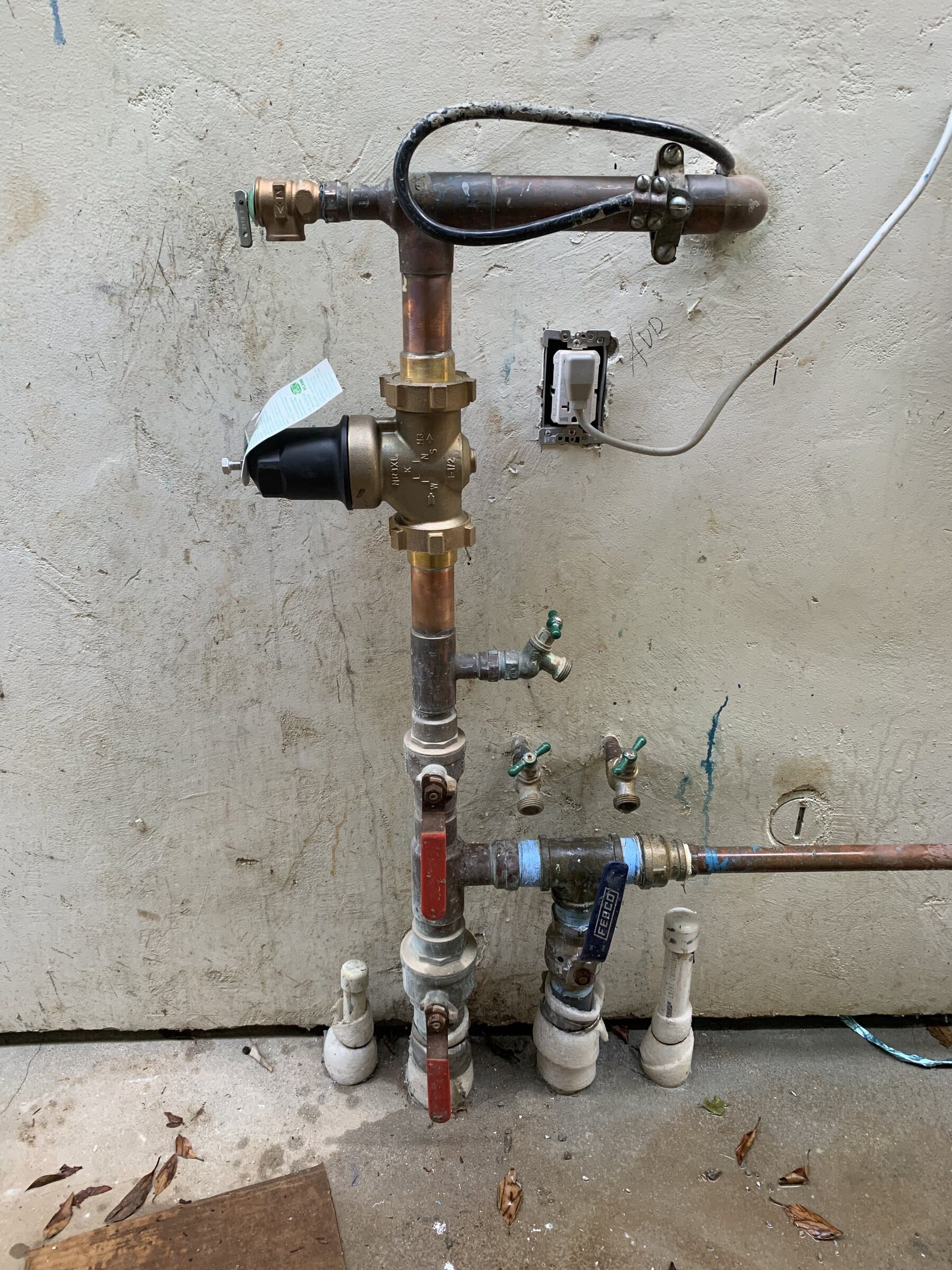
Distribution and stub-outs
Copper distribution with valved branches. Putting a shutoff on each branch means a future repair isolates one fixture instead of shutting down the whole house — a small cost now that pays for itself the first time something fails.
Common questions
Repipes, Re-Routes & Repairs, answered
I have a slab leak. Do you have to break the floor?
Usually not, and usually you should not want us to. Breaking the slab fixes one spot on a line that is the same age end to end, so it is common to be back a year later for the next failure a few feet along. A re-route abandons the failed run and carries a new line overhead or through walls — less demolition, less disruption, and the problem does not come back to the same pipe.
How do I know if I need a repipe rather than a repair?
Repetition is the tell. One leak is a repair. A second pinhole leak in the same year, rust-coloured water at first draw in the morning, or pressure that has dropped across every fixture at once means the system itself is at the end of its service life, and further patching is throwing money at it.
PEX or copper?
Both are good systems installed properly. PEX-A handles this area's water chemistry well, has far fewer joints in the wall, resists the pinhole failures that affect copper here, and costs less to install. Copper remains an excellent choice where it is exposed, where it is specified, or where a client simply prefers it. We quote what suits your house rather than what suits our week.
Do you patch the drywall?
We make the access openings and we close them cleanly. Finish-level drywall, texture matching and paint are usually handled by a finisher, and we will coordinate with yours or recommend one. We tell you this before the job rather than at the end of it.
Related services
Residential Plumbing
The everyday work: leaks, faucets, toilets, angle stops, water pressure and hot-water problems, done properly.
Drain & Rooter
Rooter service, camera inspection and sewer repair — aimed at why the line keeps backing up.
Tankless & Water Heaters
Tankless installation, service and repairs — plus tank heaters and recirculation, evaluated as a whole hot-water system.
Need repipes, re-routes & repairs?
Talk to Oscar directly — (805) 567-7808. CSLB Lic. #1140851, bonded and insured.